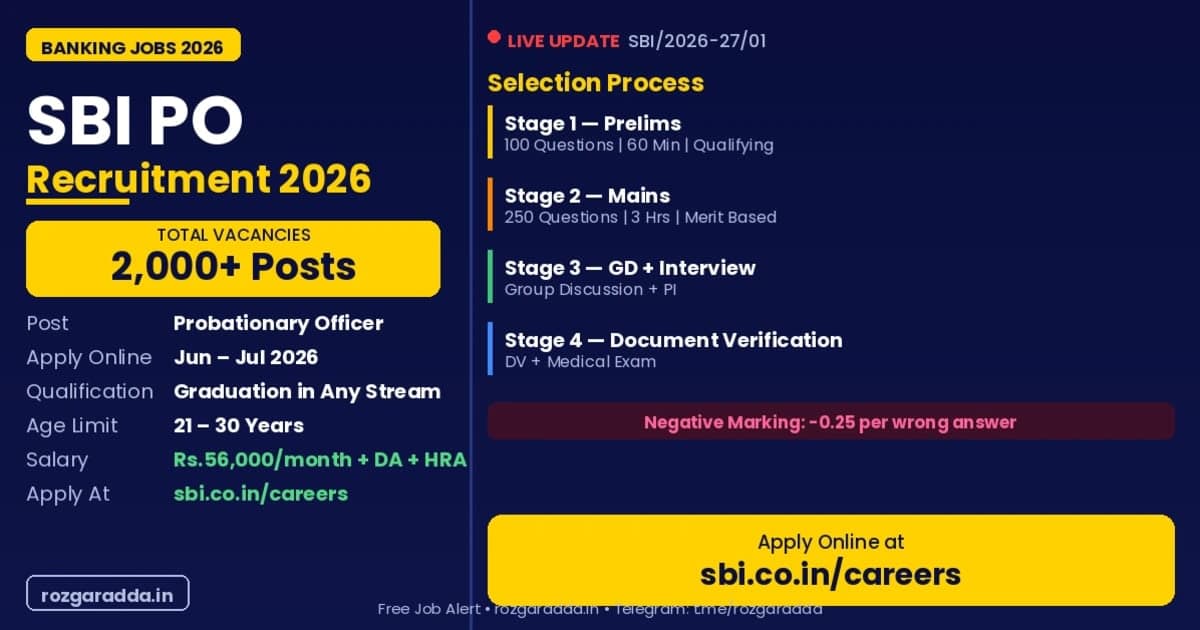
SBI PO 2026 – Complete Overview
The State Bank of India (SBI) Probationary Officer (PO) recruitment is one of India's most prestigious and competitive banking examinations. Every year, SBI releases a notification to recruit talented candidates for the PO position, which is expected to come in April-May 2026. The SBI PO exam is conducted in three stages: Preliminary, Mains, and Group Discussion with Personal Interview. This role offers exceptional career growth, competitive salary, and job security in the banking sector. The position comes with excellent benefits, including pension, medical facilities, and opportunities for promotion to senior management levels. Lakhs of candidates apply for SBI PO every year, making it one of the most sought-after government bank jobs in India. The examination follows a strict merit-based selection process, and candidates must clear all three stages to secure their position.
| Details | Information |
|---|---|
| Conducting Organization | State Bank of India (SBI) |
| Post Name | Probationary Officer (PO) |
| Job Category | Management Grade Scale I Officer |
| Minimum Qualification | Any Bachelor's Degree (any stream, any university) |
| Age Limit | 21 to 30 years as on 1 April 2026 |
| Starting Basic Pay | ₹41,960 per month |
| Approx In-hand Salary | ₹60,000 to ₹68,000 per month (metro city) |
| Application Mode | Online at sbi.co.in |
| Selection Process | Preliminary Exam, Mains Exam, Group Discussion and Personal Interview |
| Previous Year Vacancies (2025) | Approximately 2,000 to 2,500 positions |
SBI PO 2026 Expected Dates and Timeline
The SBI PO 2026 recruitment process will follow a structured timeline similar to previous years. Based on historical trends and SBI's recruitment cycle, the notification is expected to be released in April 2026. The application window typically remains open for approximately 3-4 weeks, allowing candidates to register and submit their online forms. After the application deadline, SBI conducts the Preliminary examination, which acts as a qualifying stage. Only candidates who clear the Preliminary exam with the required cutoff marks are eligible to appear for the Mains examination. The Mains exam is a more comprehensive assessment, evaluating candidates' deeper knowledge in various subjects. Following Mains, shortlisted candidates appear for Group Discussion and Personal Interview rounds. The entire recruitment process, from notification release to final result declaration, typically spans 8-9 months. This timeline gives candidates sufficient preparation time after the notification is released.
| Event | Expected Date in 2026 | Actual Date in 2025 |
|---|---|---|
| Official Notification Release | April 2026 | April 2025 |
| Online Application Start Date | April 2026 | 5 April 2025 |
| Last Date to Submit Application | May 2026 | 25 April 2025 |
| Admit Card Release (Prelims) | May 2026 | May 2025 |
| Preliminary Examination | June-July 2026 | June 2025 |
| Prelims Result Announcement | July 2026 | July 2025 |
| Admit Card Release (Mains) | July 2026 | July 2025 |
| Main Examination | August 2026 | August 2025 |
| Mains Result Declaration | September 2026 | September 2025 |
| Group Discussion and Interview Call | September 2026 | September 2025 |
| Group Discussion and Personal Interview | September-October 2026 | October-November 2025 |
| Final Result Declaration | November-December 2026 | December 2025 |
| Appointment Letter and Joining | December 2026-January 2027 | January 2026 |
SBI PO 2026 Eligibility Criteria
To be eligible for the SBI PO 2026 recruitment, candidates must meet certain educational and age requirements set by the bank. The most important eligibility criterion is that candidates must possess a valid Bachelor's degree from a recognized Indian university or equivalent. This degree can be in any stream including Commerce, Science, Arts, Engineering, or any other discipline. There is no minimum percentage requirement for the degree, which means even candidates with a basic passing grade can apply. However, final-year students can also apply provided they can provide proof of their degree completion by the time of joining. Candidates who have already obtained their degree or are expecting to graduate within the stipulated period are eligible to apply. The educational qualification requirement is flexible and inclusive, making SBI PO accessible to graduates from diverse academic backgrounds.
The age requirement is one of the critical eligibility factors for SBI PO recruitment. As on 1 April 2026, candidates must be between 21 and 30 years of age. This means a candidate must have completed 21 years of age but should not have crossed 30 years as of the specified date. Age relaxation is provided to candidates from reserved categories as per government norms. Candidates belonging to the SC and ST categories get a relaxation of 5 years, meaning they can be up to 35 years of age. Candidates from the OBC category (non-creamy layer) get a relaxation of 3 years, allowing them to be up to 33 years of age. Candidates with disabilities get relaxation of 10 years, making the upper age limit 40 years. Ex-servicemen also get specific age relaxations as per Ministry of Defence guidelines. Widows, divorcees, and women whose marriages have been dissolved also get some relaxation in age limits. Candidates must carefully check their age eligibility category before applying.
SBI PO requires candidates to be an Indian citizen or a citizen of a country that grants reciprocal citizenship to Indian citizens. Candidates must also not have been convicted or found guilty of any offense under the Criminal Procedure Code or the Indian Penal Code. Any involvement in criminal activities bars the candidate from selection. Additionally, candidates must not be an insolvent or bankrupt. The candidate's conduct and character must be good, and they should not have been dismissed from any government or banking service. Any disciplinary action taken against the candidate in the past will result in disqualification. Candidates must declare honestly all information in their application form, and any false information will lead to permanent debarment from SBI recruitment. These character-based eligibility criteria ensure that only trustworthy and ethically sound individuals are selected for the PO position.
| Eligibility Criterion | Requirement |
|---|---|
| Nationality | Indian citizen or citizen of a country that grants reciprocal citizenship to Indian citizens |
| Educational Qualification | Bachelor's degree in any discipline from a recognized university |
| Minimum Percentage | No minimum percentage required |
| Age Limit (General/EWS) | 21 to 30 years as on 1 April 2026 |
| Age Limit (OBC) | 21 to 33 years (3 years relaxation) |
| Age Limit (SC/ST) | 21 to 35 years (5 years relaxation) |
| Age Limit (PwBD) | 21 to 40 years (10 years relaxation) |
| Character and Conduct | No criminal conviction; not dismissed from service; no insolvency |
| Physical Requirements | No specific requirements; positions available for candidates with disabilities |
SBI PO 2026 Exam Pattern – Preliminary Examination
The SBI PO Preliminary examination is the first stage of the recruitment process and acts as a qualifying exam. Only candidates who clear the Preliminary exam with the required cutoff marks are eligible to take the Mains examination. The Preliminary exam is conducted online in a single shift and lasts for exactly 60 minutes. The exam consists of three sections: English Language, Quantitative Aptitude, and Reasoning Ability. Each section has a specific number of questions, and candidates must answer these within the allocated time. The questions are all multiple-choice in nature, with each correct answer awarding a fixed number of marks. There is negative marking for incorrect answers, with 0.25 marks deducted for each wrong response. Candidates must manage their time efficiently as they cannot go back to previous sections once they move forward. The Preliminary exam is designed to test basic aptitude and fundamental knowledge in the three key areas.
| Subject | Number of Questions | Total Marks | Time Allotted |
|---|---|---|---|
| English Language | 30 | 30 | 20 minutes |
| Quantitative Aptitude | 35 | 35 | 20 minutes |
| Reasoning Ability | 35 | 35 | 20 minutes |
| Total | 100 | 100 | 60 minutes |
SBI PO 2026 Exam Pattern – Main Examination
The SBI PO Main examination is a comprehensive test that evaluates candidates' in-depth knowledge in multiple areas. This exam is conducted online and consists of both objective and descriptive sections. The objective section has four main segments: Reasoning and Computer Aptitude, Data Analysis and Interpretation, General/Economy/Banking Awareness, and English Language. The descriptive section tests candidates' writing skills through essay and letter writing tasks. The entire Main examination takes 3 hours and 30 minutes to complete. The objective portion covers 200 marks total, with each section having specific marks allocation. The descriptive portion adds an additional 50 marks, making the total possible marks 250. Candidates must clear both the objective and descriptive portions to qualify. The Main exam is significantly more challenging than the Preliminary exam, requiring deeper subject knowledge and time management skills. Only candidates who clear the Main exam proceed to the Group Discussion and Personal Interview round.
| Section | Number of Questions | Total Marks | Time Duration |
|---|---|---|---|
| Reasoning and Computer Aptitude | 45 | 60 | 60 minutes |
| Data Analysis and Interpretation | 35 | 60 | 45 minutes |
| General/Economy/Banking Awareness | 40 | 40 | 35 minutes |
| English Language | 35 | 40 | 40 minutes |
| Objective Total | 155 | 200 | 180 minutes (3 hours) |
| Descriptive (Essay + Letter) | 2 questions | 50 | 30 minutes |
| Grand Total | 157 | 250 | 210 minutes (3.5 hours) |
SBI PO 2026 Detailed Syllabus
Quantitative Aptitude Syllabus
The Quantitative Aptitude section tests candidates' mathematical skills and ability to solve numerical problems quickly and accurately. This section is crucial for both Preliminary and Mains exams, though the Mains version is significantly more complex. Candidates must be proficient in various mathematical concepts including number series, simplification, approximation, data interpretation, profit and loss calculations, percentage, ratios, time and work problems, speed and distance calculations, quadratic equations, inequalities, mensuration, probability, and permutation and combination. Number series is a frequently asked topic where candidates must identify patterns in sequences of numbers. Simplification questions require the use of BODMAS rule and quick calculation skills. Data Interpretation questions involve analyzing charts, graphs, and tables to derive meaningful conclusions. These topics form the core of the quantitative section and require consistent practice for mastery. Many candidates struggle with this section due to time constraints, so speed and accuracy are essential.
- Number Series and Pattern Recognition
- Simplification and Approximation (using BODMAS rule)
- Data Interpretation (Bar graphs, Pie charts, Line graphs, Tables, Combination of charts)
- Profit, Loss, Discount, and Markup calculations
- Percentage and its applications
- Ratio, Proportion, and Mixture problems
- Simple and Compound Interest
- Time and Work relationships
- Speed, Time, and Distance problems
- Age-related problems
- Quadratic Equations and Linear Equations
- Inequalities (Linear and Quadratic)
- Mensuration (Area, Volume, Perimeter of shapes)
- Probability and Permutation and Combination
- Averages and Alligation
Reasoning Ability Syllabus
The Reasoning Ability section evaluates candidates' logical thinking, analytical skills, and ability to make inferences from given information. This is often considered the most challenging section as it requires strategic thinking and pattern recognition. Puzzles and seating arrangements are the most important topics, frequently comprising 15-20 questions out of 35 in the Preliminary exam and an even larger portion in Mains. These questions test spatial reasoning and the ability to organize information logically. Syllogism questions require understanding of logical statements and valid conclusions. Blood relation problems test the candidate's ability to understand family relationships and derive connections between individuals. Coding-decoding questions involve understanding patterns in how information is encoded and applying that understanding to decode new information. Direction sense questions test spatial orientation and the ability to track movement patterns. Inequality questions are mathematical logic problems requiring understanding of greater than, less than, and equal to relationships. Critical reasoning, found primarily in the Mains exam, evaluates the candidate's ability to evaluate arguments and statements for logical validity. Mastering this section requires extensive practice with different problem types.
- Puzzles and Seating Arrangements (Linear, Circular, Square, Hexagonal arrangements)
- Syllogism and Logical Statements
- Blood Relations and Family Trees
- Coding-Decoding and Pattern Recognition
- Direction and Distance Sense
- Inequality and Logical Reasoning
- Input-Output Pattern Analysis
- Series and Sequence
- Analogy and Classification
- Statement and Conclusion
- Statement and Assumption
- Critical Reasoning (Mains level)
- Ranking and Ordering
- Conditional Logic
- Data Sufficiency
English Language Syllabus
The English Language section assesses candidates' proficiency in English grammar, vocabulary, and comprehension skills. Reading Comprehension is a major component where candidates must read passages and answer questions based on the information provided. The passages test understanding of main ideas, supporting details, inferences, and vocabulary in context. Error Detection questions require identifying grammatical errors in sentences and understanding correct English grammar rules. Fill in the Blanks exercises test vocabulary knowledge and the ability to choose contextually appropriate words. Para Jumbles require rearranging sentences to form a coherent paragraph, testing logical flow and understanding of sentence relationships. Sentence Improvement questions ask candidates to identify the best way to rewrite a sentence. Cloze Test presents passages with missing words, requiring candidates to fill in appropriate words based on context. The Descriptive section in Mains requires writing an essay of approximately 250 words and a letter of approximately 150 words on given topics. These writing tasks assess candidates' ability to express ideas clearly, organize information logically, and use correct grammar and vocabulary. Proficiency in English requires regular reading and writing practice.
- Reading Comprehension (2-3 passages, 8-12 questions)
- Error Detection and Correction
- Fill in the Blanks (Single and Multiple)
- Para Jumbles (Sentence Rearrangement)
- Sentence Improvement and Paraphrase
- Cloze Test
- Vocabulary and Synonyms/Antonyms
- Phrase and Idiom Meanings
- Grammar (Tenses, Agreement, Articles, Prepositions)
- Spelling Correction
- Descriptive Writing (Essay on current topics)
- Letter Writing (Formal and Business letters)
- Word Usage and Context
- Subject-Verb Agreement
- Pronoun Reference
General Awareness, Economy, and Banking Awareness Syllabus
The General Awareness and Banking Awareness section tests candidates' knowledge of banking sector, economic policies, government schemes, and current affairs. This section is critical as it directly relates to the banking profession and requires regular updates on current events. Understanding the Reserve Bank of India's functions and role in the Indian economy is fundamental. Candidates must know about monetary policy, inflation control, and the RBI's regulatory functions. Banking terminology such as NPA (Non-Performing Assets), CRR (Cash Reserve Ratio), SLR (Statutory Liquidity Ratio), Repo Rate, and Reverse Repo Rate are essential concepts. Knowledge of government schemes like Prime Minister Jan Dhan Yojana, Pradhan Mantri Mudra Yojana, and other social security schemes is important. Budget highlights and economic survey key points are frequently tested. Current banking news including mergers, acquisitions, and new banking services must be followed. Understanding the digital banking revolution and technology in banking is increasingly important. Candidates must read newspapers daily, follow news channels, and maintain updated notes on current affairs for effective preparation in this section.
- Reserve Bank of India (RBI) structure and functions
- Monetary Policy and its objectives
- Interest Rates, Inflation, and Deflation
- Banking Regulation and Supervision
- Banking Terms and Concepts (NPA, CRR, SLR, Repo Rate)
- Financial Inclusion and Digital Banking
- Payment Systems and Technologies (NEFT, RTGS, IMPS, UPI)
- Government Schemes (Jan Dhan, MUDRA, PMJDY, PM-JAY)
- Priority Sector Lending
- Banking Security and Fraud Prevention
- Foreign Exchange and International Banking
- Stock Market and Securities Regulation
- Budget and Economic Survey highlights
- Current Banking News and Mergers/Acquisitions
- International Banking Organizations (IMF, World Bank, Asian Development Bank)
Application Fee Structure for SBI PO 2026
The application fee is a mandatory charge that candidates must pay while submitting their online application for SBI PO recruitment. This fee is non-refundable and is collected to process the application. The fee structure differs based on the candidate's category, with reserved category candidates and those with disabilities receiving concessions. General category, Other Backward Classes (OBC), and Economically Weaker Sections (EWS) candidates must pay the full application fee. Scheduled Caste (SC), Scheduled Tribe (ST), and Persons with Disability (PwBD) candidates are completely exempt from paying the application fee. The fee can be paid through online banking, credit card, debit card, or other online payment methods. It is essential to verify the correct fee amount on the official SBI website before applying. Candidates should keep a record of their fee payment confirmation for future reference. In case of any technical issues during fee payment, candidates should contact SBI's customer support service.
| Candidate Category | Application Fee | Remarks |
|---|---|---|
| General Category | ₹750 | Full fee applicable |
| Other Backward Classes (OBC) | ₹750 | Full fee applicable |
| Economically Weaker Sections (EWS) | ₹750 | Full fee applicable |
| Scheduled Caste (SC) | Nil (Exempt) | No fee required |
| Scheduled Tribe (ST) | Nil (Exempt) | No fee required |
| Persons with Disability (PwBD) | Nil (Exempt) | No fee required |
SBI PO Salary Structure and In-Hand Earnings
The SBI PO position offers an attractive and competitive salary package that makes it one of the most sought-after jobs in the banking sector. The salary structure consists of various components including basic pay, dearness allowance, house rent allowance, special allowance, and other perks. The starting basic pay for a Probationary Officer is ₹41,960 per month, which is a solid foundation for career growth. On top of the basic pay, candidates receive dearness allowance (DA) which is linked to inflation and typically constitutes about 50% of the basic pay. House rent allowance (HRA) is paid based on the city of posting and varies from metro cities (9%) to tier-2 cities (7%) and tier-3 cities (5%). Special allowance is an additional component added to compensate for various expenses. CCA (City Compensatory Allowance) is provided to candidates posted in specified cities. The gross salary after all these allowances typically ranges from ₹68,000 to ₹73,000 per month depending on the location of posting. The in-hand salary after deductions for income tax, provident fund, and other statutory deductions ranges from ₹60,000 to ₹68,000 per month. Additionally, candidates receive performance bonus, medical benefits, life insurance, and pension scheme benefits. The salary increases annually through increments, and candidates have numerous opportunities for promotion which significantly increases earnings.
| Salary Component | Amount (Approximate) | Remarks |
|---|---|---|
| Basic Pay | ₹41,960 | Starting salary |
| Dearness Allowance (DA) | ₹20,980+ | Approximately 50% of basic pay, increases with inflation |
| House Rent Allowance (HRA) - Metro | ₹3,776 | 9% of basic pay for metro cities |
| House Rent Allowance (HRA) - Tier-2 | ₹2,938 | 7% of basic pay for tier-2 cities |
| House Rent Allowance (HRA) - Tier-3 | ₹2,098 | 5% of basic pay for tier-3 cities |
| Special Allowance | ₹5,396 | Additional compensation |
| City Compensatory Allowance (CCA) | ₹870 | For specified cities |
| Gross Salary (Metro City) | ₹73,000 (Approximately) | Before deductions |
| Net In-Hand Salary (Metro City) | ₹60,000 to ₹68,000 | After income tax, provident fund, and other deductions |
SBI PO Previous Year Cutoff Scores
Understanding previous year cutoff scores helps candidates set realistic targets and gauge the competition level for SBI PO recruitment. Cutoff scores are the minimum marks required to qualify each stage of the examination. The Preliminary exam has category-wise cutoffs, meaning different categories require different minimum scores to advance to the Mains exam. The General/Unreserved category typically has the highest cutoff, requiring candidates to score significantly higher than other categories. OBC (non-creamy layer) candidates have a moderately lower cutoff compared to General category. SC and ST candidates benefit from lower cutoffs, making it relatively easier for them to qualify. It is important to note that cutoff scores vary based on factors such as the total number of applicants, difficulty level of the exam, and the number of positions available. The cutoff scores have been gradually increasing over the years due to rising competition and improved preparation standards among candidates. The most recent years show higher cutoff scores compared to earlier years, indicating increasing difficulty and competition. Candidates should use these cutoff ranges as a benchmark for their preparation and aim to score well above the expected cutoff to ensure their qualification.
| Category | 2025 Cutoff (Approx) | 2024 Cutoff (Approx) | 2023 Cutoff (Approx) |
|---|---|---|---|
| General / UR | 60 to 65 marks | 62 to 66 marks | 58 to 64 marks |
| OBC (Non-Creamy Layer) | 56 to 62 marks | 58 to 63 marks | 54 to 60 marks |
| SC | 48 to 54 marks | 50 to 56 marks | 46 to 52 marks |
| ST | 42 to 50 marks | 44 to 52 marks | 40 to 48 marks |
Selection Process Overview
The SBI PO recruitment process consists of three main stages that test candidates' different competencies and abilities. The first stage is the Preliminary examination, which is a qualifying exam designed to filter candidates based on basic aptitude and fundamental knowledge. Candidates who score above the category-wise cutoff in the Preliminary exam proceed to the Main examination. The Main examination is more comprehensive and challenging, testing deeper subject knowledge and conceptual understanding. The Mains exam includes both objective questions and a descriptive writing component, assessing candidates' practical ability to apply knowledge and express ideas clearly. After the Main examination results, candidates are shortlisted based on their scores for the Group Discussion and Personal Interview round. The GD/PI round evaluates candidates' communication skills, leadership potential, decision-making ability, and fit with the organizational culture. The final selection is based on the combined performance across all three stages, with the Mains exam and GD/PI typically having higher weightage. Candidates must clear each stage before progressing to the next, and their performance in each stage is important for final selection.
Selection Process – Group Discussion and Personal Interview
The Group Discussion and Personal Interview round is the final stage of SBI PO selection and is crucial in determining the final merit list. Group Discussion typically involves a group of 10-12 candidates discussing a given topic for 10-15 minutes. The GD evaluates candidates' ability to listen, participate constructively, present ideas logically, and work collaboratively. Topics for GD are usually related to current affairs, business, economy, social issues, or banking sector. The Personal Interview is a one-on-one interaction between the candidate and the interview panel consisting of 3-4 members. The interview assesses the candidate's subject knowledge, communication skills, confidence, career goals, and suitability for the role. Candidates are asked questions about their background, education, career aspirations, knowledge of banking, and general awareness. The interview panel also evaluates the candidate's body language, response to questions under pressure, and overall personality. Both GD and PI typically carry equal weightage in the selection process. Candidates must perform well in both components to secure final selection. Preparation for this round requires practicing mock group discussions, improving communication skills, and developing strong knowledge of current affairs and banking sector.
Documents Required for SBI PO Application
Candidates applying for SBI PO must prepare and have certain documents ready for upload during the online application process. The application form requires candidates to upload scanned copies of essential documents to verify their identity and credentials. A valid government-issued photo identity document such as a passport, Aadhaar card, voter ID, or driving license is mandatory. Candidates must also upload their educational certificate or degree proving they have completed the required qualification. A recent color passport-sized photograph is required for the application. Candidates belonging to reserved categories must have their caste certificate issued by appropriate government authority. Proof of category (SC/ST/OBC) with the candidate's name and registered number is essential. The application process also requires candidates to upload their signature as a digital image. In case of any discrepancy or inconsistency, the bank may seek original documents during verification. It is advisable for candidates to keep all original documents safe as they will be required during the final verification stage and at the time of appointment.
How to Apply for SBI PO 2026 – Step by Step Guide
The application process for SBI PO 2026 is entirely online and must be completed through the official SBI website. Candidates should follow the step-by-step procedure carefully to avoid any errors or omissions that might lead to rejection of their application. The first step is to visit the official SBI website (sbi.co.in) and locate the recruitment section or careers page. Candidates should look for the SBI PO recruitment notification and carefully read all the instructions and eligibility criteria. Once the application link becomes active on the specified date, candidates can click on it to start the application process. Before beginning the application, candidates should gather all necessary information and documents including educational details, personal information, and scanned copies of required documents.
The registration process requires candidates to create a new account on the SBI recruitment portal. Candidates must provide their email address and mobile number for account creation and verification. A password must be created for future login access. Once the account is created, candidates receive a confirmation email and OTP on their registered mobile number, which must be verified. After successful registration and verification, candidates can log in to their account and begin filling the application form. The application form has multiple sections including personal information, educational background, category details, and contact information. Candidates must fill all mandatory fields marked with an asterisk. Any incorrect or incomplete information can lead to rejection of the application. Care must be taken while entering the date of birth, as this determines age eligibility.
After filling the personal information, candidates must upload the required documents in the specified format and size. Documents must be uploaded in JPEG or PDF format with file size between 20 KB and 200 KB as per the specifications. The photograph should be a recent color image with white background, and the signature should be scanned clearly. All documents must be legible and clearly visible for verification purposes. After uploading documents, candidates must review their application to ensure all information is correct and complete. The application form should not be submitted until candidates are absolutely certain about the details provided. Once submitted, the application cannot be edited or modified in most cases.
The final step involves payment of the application fee through online banking, debit card, credit card, or other digital payment methods. Candidates should verify the correct fee amount for their category and complete the payment process. A payment confirmation receipt must be saved for future reference. After successful payment, a confirmation message and application reference number are provided. Candidates should note down the application reference number and use it for future correspondence regarding their application. The entire online application process must be completed before the official deadline, as no late submissions are accepted. Candidates are advised to apply well before the last date to avoid server congestion and technical issues.
Preparation Tips and Strategy for SBI PO 2026
Effective preparation requires a well-planned strategy and consistent effort over several months. The ideal preparation period for SBI PO is approximately 4-6 months, allowing sufficient time to cover all topics comprehensively. Candidates should start their preparation by thoroughly understanding the exam pattern, syllabus, and marking scheme. Understanding what is being tested helps candidates focus their preparation efforts appropriately. Creating a detailed study plan with clear objectives for each week is essential for staying on track. The plan should allocate specific time slots for each subject based on the candidate's strengths and weaknesses. For quantitative aptitude, candidates should master fundamental concepts before attempting complex problems. Regular practice with numerical problems and data interpretation questions is crucial for building speed and accuracy. Candidates should solve at least 50-100 DI questions daily to develop the ability to analyze data quickly and accurately.
For reasoning ability, candidates must practice puzzles and seating arrangements extensively as these form a significant portion of the exam. Working through 10-15 puzzle sets daily helps develop logical thinking and speed. Candidates should practice different types of arrangements including linear, circular, square, and hexagonal arrangements. For the English language section, candidates should focus on improving vocabulary and grammar through regular reading. Reading English newspapers, magazines, and online articles helps improve reading comprehension skills and vocabulary. Candidates should practice essay and letter writing to develop writing skills for the descriptive section. Writing 2-3 essays and letters daily helps improve the ability to express ideas clearly and coherently. Mock tests are absolutely essential for SBI PO preparation and should be taken regularly, ideally one full-length mock test daily starting 2-3 months before the actual exam. Analyzing mock test performance helps identify weak areas and areas needing improvement.
For banking awareness and general knowledge, candidates should read newspapers daily, particularly sections related to banking, economy, and government policies. Following financial news channels and reading official announcements from RBI and government sources helps stay updated with current developments in the banking sector. Candidates should maintain a dedicated notebook for important banking terms, concepts, and current affairs. Regular revision of notes ensures information retention. Taking coaching from reputable institutes can provide structured guidance and access to quality study materials. However, self-study combined with online resources can also be highly effective if pursued with discipline. Time management during the exam is critical, and candidates should practice solving questions within the allocated time limits. Candidates should solve previous year question papers to understand the exam pattern and types of questions asked. Maintaining physical and mental health during preparation is equally important, with candidates ensuring adequate sleep, regular exercise, and balanced diet. Finally, maintaining a positive attitude and confidence is crucial for success in this highly competitive examination.
SBI PO Career Progression and Growth
The SBI PO position offers excellent opportunities for career growth and advancement within the banking organization. Upon selection and successful completion of the 2-year probation period, candidates are confirmed as permanent employees and designated as Junior Management Grade Scale I officers. The career progression path in SBI is well-structured with clear promotion criteria and timelines. From Scale I, candidates can be promoted to Middle Management Grade Scale II, which comes with increased responsibilities and higher salary. The progression typically follows a hierarchical structure with opportunities to reach senior management positions. Candidates with outstanding performance and additional qualifications can accelerate their promotion timeline. Many SBI officers who started as POs have reached the position of General Manager, the highest position in the organization. The career growth depends on factors such as performance appraisals, specialization in specific areas, and completion of management training programs conducted by SBI's training institutes. Candidates can develop expertise in various functional areas including credit, operations, technology, or human resources. Pursuing additional qualifications such as MBA or specialized banking certifications can enhance career prospects and open doors to higher positions. The organization encourages continuous learning and development of its officers through various training programs and skill development initiatives. With dedication and consistent performance, SBI PO position can lead to a highly rewarding and successful banking career spanning 30+ years.
| Designation | Pay Level | Approximate Salary Range | Experience Level |
|---|---|---|---|
| Probationary Officer (PO) | Scale I (Training) | ₹41,960 basic | 0-2 years |
| Junior Management Grade Scale I | Scale I (Permanent) | ₹41,960 to ₹89,890 | After confirmation (2+ years) |
| Middle Management Grade Scale II | Scale II | ₹48,170 to ₹69,810 | 4-6 years |
| Senior Manager (MMGS-III) | Scale III | ₹63,840 to ₹78,230 | 8-10 years |
| Senior Management Grade Scale IV | Scale IV | ₹76,010 to ₹89,890 | 12-15 years |
| Chief Manager | Scale V | ₹84,850 to ₹1,05,750 | 16-20 years |
| Asst. General Manager | Scale VI | ₹1,01,450 to ₹1,27,140 | 22-25 years |
| Deputy General Manager | Scale VII | ₹1,18,850 to ₹1,50,920 | 26+ years |
SBI PO vs IBPS PO – Comparison
Both SBI PO and IBPS PO are highly sought-after banking positions, but they differ in various important aspects. SBI PO is recruitment for the State Bank of India exclusively, while IBPS PO conducts recruitment for 11 public sector banks simultaneously. This fundamental difference affects the number of positions available, with IBPS typically offering more vacancies but across multiple banks. The starting basic salary for SBI PO is ₹41,960, which is higher than IBPS PO starting salary of ₹36,000, making SBI PO financially more attractive. However, the salary progression and final salary ceiling may be comparable or even superior in some IBPS banks. SBI holds the prestige of being India's largest and oldest bank, and the SBI PO position carries higher social recognition and status. The exam difficulty level for SBI PO is typically considered slightly higher than IBPS PO, with more complex questions and tighter time constraints. The number of applicants is different, with SBI PO attracting over 2 lakh applicants while IBPS PO attracts over 5 lakh applicants, indicating higher competition in IBPS PO. The exam pattern is similar between both, but the specific topics and weightage may vary slightly. For career progression, SBI offers a clearer hierarchical structure with well-defined promotion timelines. Most banking professionals prefer SBI PO due to its prestige, higher starting salary, and well-structured career growth. However, IBPS PO is also an excellent opportunity with more vacancies and the option to choose from multiple banks based on preference. Candidates often apply for both exams as they are conducted in different timeframes, providing multiple opportunities for selection.
| Comparison Factor | SBI PO | IBPS PO |
|---|---|---|
| Recruitment Organization | State Bank of India (single bank) | 11 public sector banks via IBPS |
| Number of Vacancies | 2,000-2,500 (approx) | 4,000-5,000+ (approx) |
| Starting Basic Pay | ₹41,960 per month | ₹36,000 per month (varies by bank) |
| Prestige and Status | Highest (India's largest bank) | High (but varies by bank) |
| Exam Difficulty Level | Slightly Higher | Moderate |
| Number of Applicants | 2 lakh+ | 5 lakh+ |
| Competition Level | Very High | Extremely High |
| Career Growth | Well-structured with clear hierarchy | ❓ Frequently Asked Questions›State Bank of India (SBI) mein salary kitni milegi?Is post ke liye salary Rs.41960-89890 hogi. Pay Matrix aur allowances ke baare mein official notification se confirm karein. ›SBI PO 2026 Notification – Apply Online, Exam Date, Eligibility, Syllabus, Salary ki official notification kahan se download karein?SBI PO 2026 Notification – Apply Online, Exam Date, Eligibility, Syllabus, Salary ki official notification State Bank of India (SBI) ki official website se download kar sakte hain. RozgarAdda par bhi notification ka direct link diya gaya hai. Advertisement ⚠️ Disclaimer: Information provided is for reference only. Verify from official website before applying.  Badal HariAdministrator RozgarAdda.in Admin — Managing government job updates, results and admit cards. 🔥 Similar Banking Jobs Jobs 20266 Active JobsBanking Jobs PNB Local Bank Officer LBO Recruitment 2026 for 545 Posts🔴 Application ClosedView Details → Banking Jobs IBPS RRB Result 2026🟢 ActiveView Details → Banking Jobs RBI Assistant Recruitment 2026🟢 ActiveView Details → Banking Jobs RBI Grade B Recruitment 2026🟢 ActiveView Details → Banking Jobs SBI PO Admit Card 2026🟢 ActiveView Details → Banking Jobs IBPS Clerk Cut Off 2026🟢 ActiveView Details → You might also likeSPONSORED |